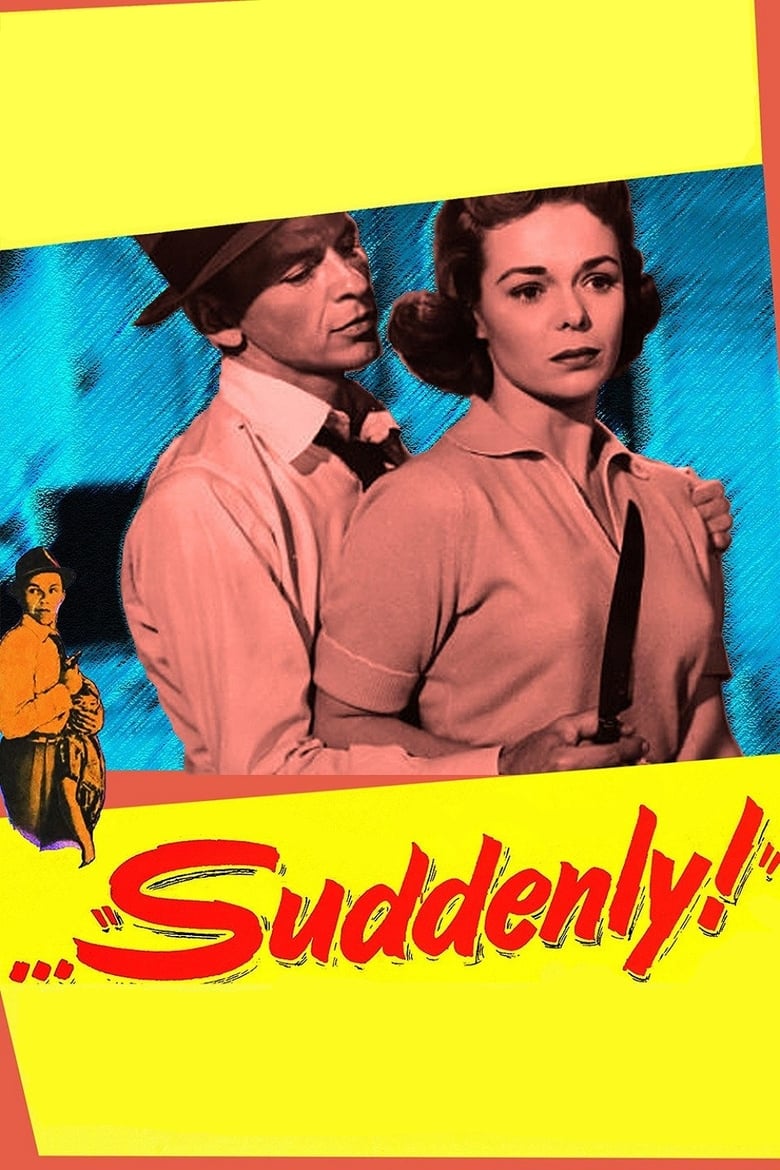
In the quiet California town of Suddenly, Sheriff Tod Shaw presides over a community so uneventful that his greatest concern is the romantic distance between himself and Ellen Benson, a war widow raising her young son Pidge with the help of her father-in-law, retired Secret Service agent Pop Benson. The town's torpor is shattered when word arrives that the President of the United States will pass through Suddenly by train, prompting a routine security sweep that quickly turns lethal.
Three men – John Baron and his two hired associates – seize the Benson house, which commands a direct sightline to the train platform, and take the family hostage alongside Shaw and the Secret Service detail. Baron, a Korean War veteran turned contract killer, is being paid to assassinate the President from the upstairs window. As the hours compress toward the train's arrival, allegiances within the house shift under pressure: Baron's partners grow uncertain, Pop Benson works quietly against his captors, and Shaw must calculate risk against the lives in his care.
Suddenly belongs to a tight subgenre of postwar noir in which the threat is not the city's corruption but a specific, purposeful violence imported into a space that had believed itself safe. The film uses its contained setting – a single house, a handful of rooms – to examine how ordinary people behave when confronted with a man who has reduced killing to professional routine, and how the residue of wartime experience shapes both the killer and those who must stop him.
Suddenly arrives at a curious intersection: it is a hostage thriller with the architecture of noir, and it earns its genre credentials less through visual excess than through psychological economy. Frank Sinatra's John Baron is the film's central achievement – a man whose self-regard has curdled into ideology, who justifies assassination by measuring his own war record against a society he believes discarded him. The performance is controlled and genuinely unsettling, all the more so for being delivered two years before Sinatra's critical rehabilitation with The Man with the Golden Arm. Lewis Allen, who had already demonstrated an aptitude for confined dread in The Uninvited, keeps the camera close and the editing patient, trusting the situation's inherent pressure rather than manufacturing momentum through incident. Sterling Hayden's Shaw is the necessary counterweight – a man of routine authority learning, in real time, the difference between peacetime law enforcement and mortal confrontation. The film's postwar anxiety is not decorative; it is structural. Baron's pathology is presented as a product of the war the country has chosen to forget, and that argument gives the film a moral weight that outlasts its modest running time.
– Classic Noir
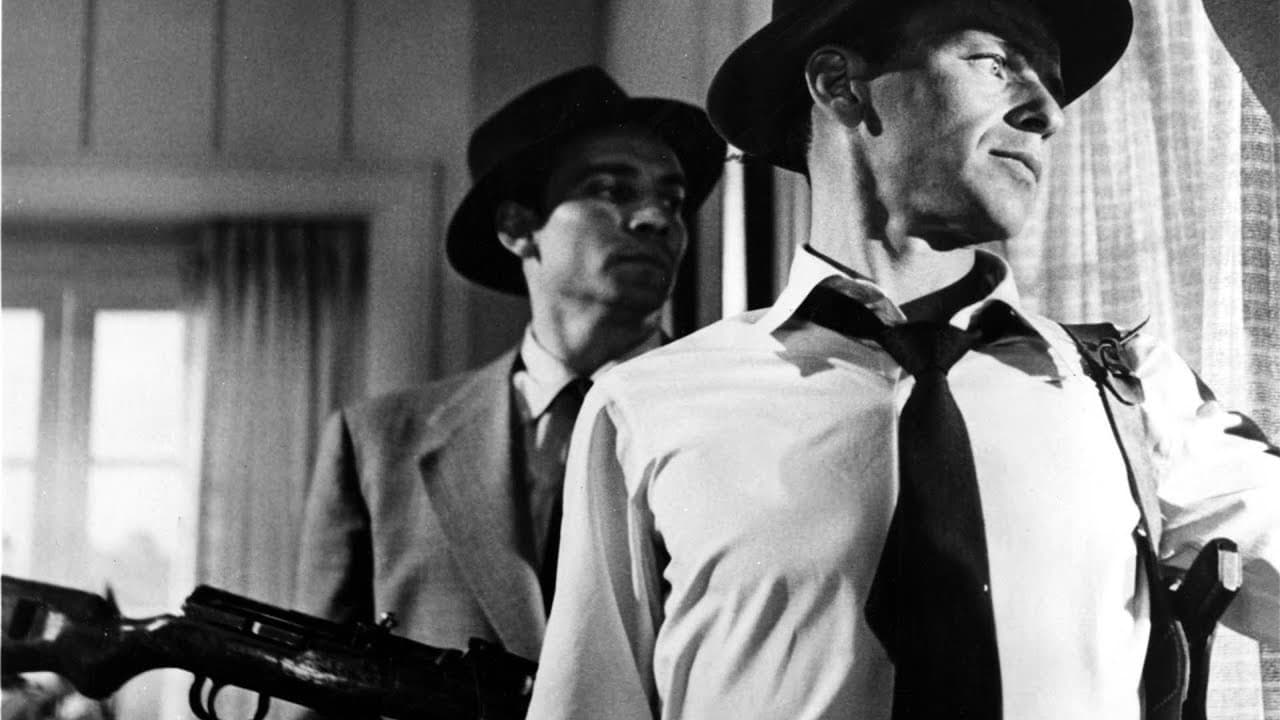
Charles G. Clarke frames Baron at the upstairs window in a composition that places him between the domestic interior – its furniture, its family photographs, its radio – and the open sight line to the platform below. The light falls hard from outside, casting Baron's face in partial shadow while the room behind him recedes into soft grey. Clarke uses a shallow field of focus to isolate Baron's hands on the rifle, drawing the eye to the instrument of the planned act while the human context blurs away. The camera does not dramatize the moment; it simply holds, allowing the geometry of the shot to make its own argument about what this man has become.
The scene is the film's clearest statement of its central proposition: that Baron has reorganized his interior life around a single mechanical function. His conversation in these moments is calm, even affable, which is more disturbing than any display of rage would be. The window becomes a moral threshold – on one side, the world of consequence and relationship that the Bensons represent; on the other, the clean abstraction of the target. Baron's ease in this position tells us that the war did not break him so much as complete a process already underway.
Charles G. Clarke shoots Suddenly almost entirely within the confined rooms of the Benson house, and the restriction is turned to deliberate effect. Working with what appears to be a standard spherical lens package suited to the Academy ratio, Clarke develops a grammar of enclosure: ceilings visible in wide shots, furniture used as foreground mass to compress the frame, windows functioning as both light source and symbolic threshold. The exterior daylight – the film takes place largely in afternoon and early evening – is kept bright and somewhat flat against the interior, so that the house itself reads as a trap lit from without. Shadow work is selective rather than expressionistic; Clarke reserves deep shadow for Baron specifically, allowing the other characters to exist in more naturalistic illumination, which quietly marks him as the noir element in an otherwise ordinary domestic space. The approach serves the film's moral logic: the darkness is not everywhere, it has arrived with one man, and the cinematography locates it precisely.
Suddenly entered the public domain and is available on Archive.org in multiple transfers; print quality varies, but several reasonably clean versions circulate at no cost.
TubiFreeTubi has carried Suddenly as part of its classic film library; the transfer is generally serviceable for a public-domain title, with the platform's standard ad interruptions.
Amazon Prime VideoSubscriptionAvailability on Prime Video fluctuates given the film's public-domain status, but it has appeared there in passable condition – confirm current availability before seeking it out.