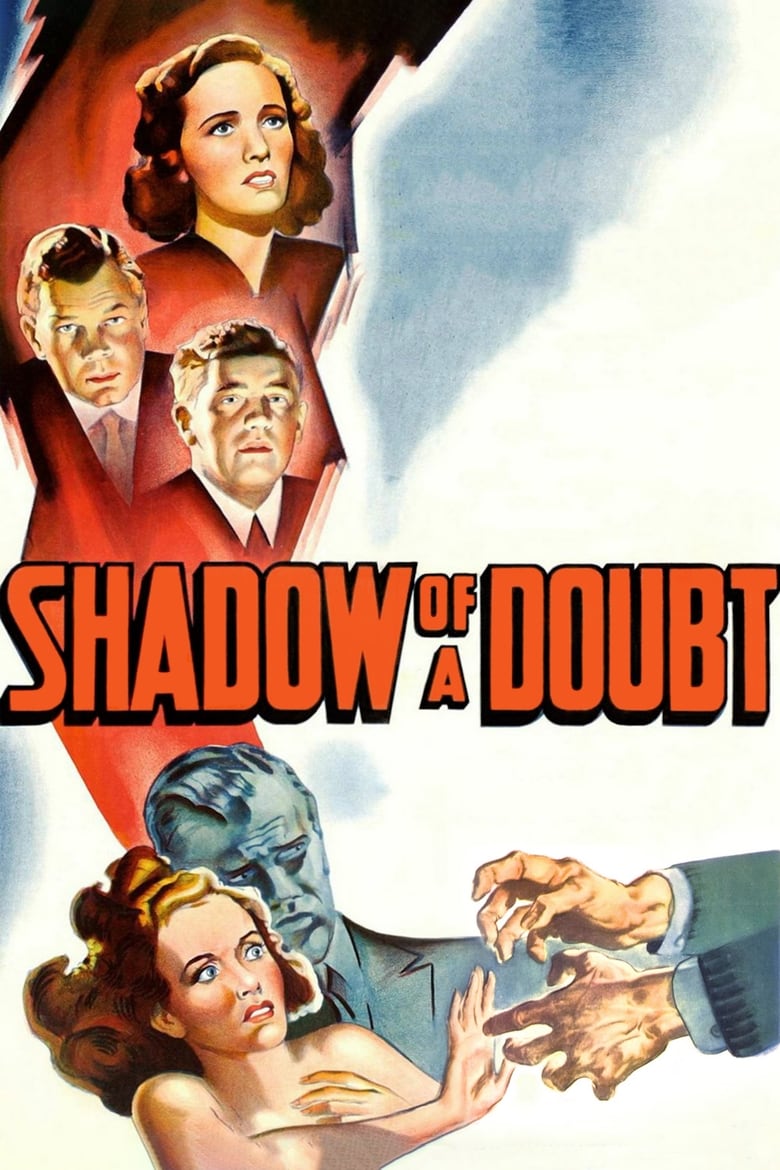
Young Charlie Newton (Teresa Wright) lives in the placid California town of Santa Rosa, restless and quietly dissatisfied with the comfortable ordinariness of her life. When her beloved Uncle Charlie (Joseph Cotten) arrives unannounced from the East, his charm and sophistication seem to answer her longing for something larger than her provincial surroundings. He is, to her, proof that the world contains glamour and mystery – and she adores him without reservation.
Two federal detectives follow Uncle Charlie to Santa Rosa, ostensibly conducting a survey but in fact investigating him as the prime suspect in a series of murders of wealthy widows. Young Charlie, slowly assembling evidence she would prefer not to find, is forced to confront what her uncle may be – and what it means that she recognized something of herself in him. The film turns on this doubling: two Charlies, one innocent and one perhaps irredeemably corrupt, bound by name, blood, and an unnerving psychic sympathy neither can fully explain.
Shadow of a Doubt operates at the intersection of domestic melodrama and criminal thriller, using the grammar of noir – the hidden past, the fatal secret, the collapse of a safe world – without the urban nightscapes the genre typically requires. Hitchcock plants his darkness inside a white-picket-fence America, arguing that violence and moral rot are not imported from outside but grow quietly at the center of ordinary life.
Shadow of a Doubt holds a peculiar position in the noir canon: it achieves the genre's essential moral vision without most of its visual conventions. There are no rain-slicked streets, no femme fatales in lamplight, no urban labyrinths. Instead, Hitchcock and cinematographer Joseph A. Valentine photograph sunlit storefronts, family dinners, and neighborhood porches – and make them feel increasingly sealed and suffocating. The film's real subject is the myth of American safety: how readily a community accepts what it wants to see, how ill-equipped domestic life is to accommodate genuine evil. Joseph Cotten's performance is the film's sharpest instrument, projecting warmth and contempt in equal measure and never permitting the audience to feel entirely comfortable in their own suspicion. Released in 1943, during a war fought explicitly in the name of ordinary American virtue, the film's suggestion that such virtue might be a convenient fiction carries an unease that no amount of resolution can fully dispel.
– Classic Noir
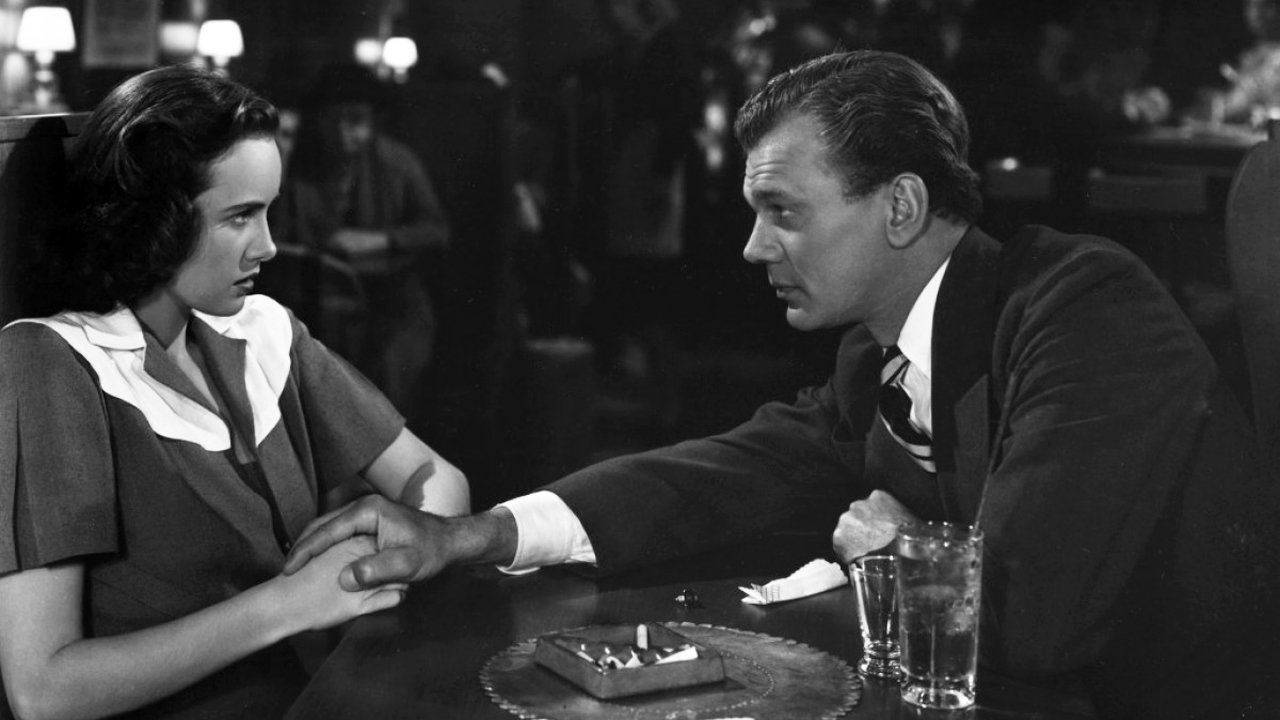
Uncle Charlie holds court at a corner table, the frame tight and the background deliberately shallow, isolating him from the bar's ambient noise. Valentine's lighting falls at a steep angle, carving shadow across one half of Cotten's face while leaving the other in warm, social light – a composition that visualizes the film's central argument about doubled surfaces. Young Charlie sits across from him, the camera cutting between her stillness and his controlled animation, the editing rhythm slowing as his words grow more precise and more revealing.
The scene crystallizes what the film has been constructing: Uncle Charlie's contempt for the women he has killed is not madness but ideology, articulated with the confidence of a man who has never been required to account for himself. Young Charlie's expression does not collapse into horror – it hardens into recognition. She understands him, and she understands that this understanding is its own kind of contamination. The scene does not pivot the plot so much as close a door that cannot be reopened.
Joseph A. Valentine's cinematography for Shadow of a Doubt represents one of the period's more disciplined exercises in subverting expectation. Where noir convention called for high-contrast urban darkness, Valentine photographs Santa Rosa in deep-focus daylight that refuses to look threatening – until Hitchcock requires it to. Interior scenes shift the calculus: Valentine uses hard single-source lighting in the Newton house to introduce shadow where the script has not yet earned it, conditioning the viewer's unease ahead of the narrative. The bar confrontation and the staircase sequences use low angles and compressed framing to convert domestic architecture into something oppressive. Shot predominantly on location in Santa Rosa – an unusually naturalistic choice for a studio production of the period – the film's visual world feels authenticated and therefore more vulnerable to the corruption Hitchcock is tracing. The gap between Valentine's clean, legible images and what they are made to contain is precisely where the film's moral argument lives.
The Criterion Channel presents the film in a clean transfer that preserves Valentine's high-contrast interior lighting without crushing the shadow detail.
PeacockSubscriptionAvailable on Peacock as part of Universal's classic library holdings, making it accessible without a specialty streaming subscription.
TubiFreeA free ad-supported option that periodically carries the film; transfer quality varies, but the availability is consistent.