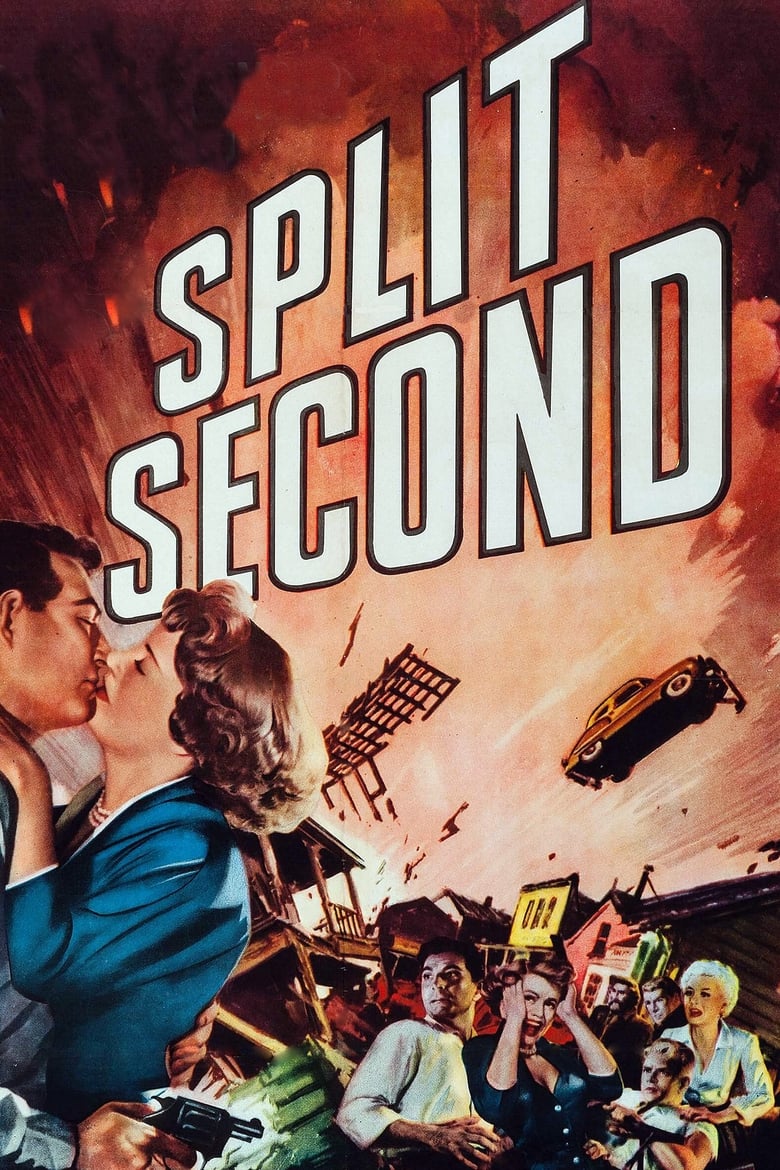
Escaped convict Sam Hurley, ruthless and cornered, seizes a disparate group of civilians at gunpoint and forces them to accompany him into the Nevada desert. Among the captives are Kay Garven, a woman of cool intelligence traveling with her husband Neal, a physician; Dorothy Vale, a showgirl whose brittle toughness masks genuine fear; and Arthur Ashton, a newspaper man whose instinct for self-preservation overrides any professional courage. Hurley needs time, distance, and silence – and he is willing to kill for all three.
The desert location is no accident. Hurley has chosen an abandoned town within the test range of an imminent atomic detonation, calculating that no pursuit will follow him there. As the group waits under the Nevada sun, allegiances shift. Kay finds herself navigating the space between Hurley's volatile attention and her husband's increasingly strained composure. Dorothy, sharp-tongued and privately desperate, reads Hurley with the accuracy of a woman who has spent her life around dangerous men. Larry Fleming, a hitchhiker drawn into the situation, represents whatever residual idealism the film permits itself, though the screenplay treats that quality with skepticism.
Split Second uses the countdown structure familiar from B-picture thrillers but presses it into the service of something closer to psychological siege drama. The atomic test deadline functions less as spectacle than as a moral accelerant, forcing each character toward a disclosure they might otherwise have deferred indefinitely. The film belongs to a strand of early-1950s noir shaped by Cold War unease – one in which annihilation is not metaphorical but administrative, scheduled, and utterly indifferent to the lives caught beneath it.
Split Second is Dick Powell's debut as a director, and it is a more assured piece of work than its B-picture origins might suggest. Powell had spent the previous decade remaking himself from musical lead into hard-boiled actor, and something of that self-conscious reinvention informs the film's tone. Stephen McNally's Hurley is not romanticized: he is vicious, tactical, and without the existential grandeur that noir sometimes extends to its criminals. What the film earns is a genuine atmosphere of entrapment – physical, moral, and finally geological, given the blasted Nevada landscape. Jan Sterling brings her characteristic acidity to Dorothy Vale, a performance that cuts through the film's more conventional elements. Nicholas Musuraca's cinematography, drawing on the same visual economy he brought to Out of the Past, makes the open desert feel as claustrophobic as any rain-soaked city street. As a document of early Cold War anxiety, the film is quietly instructive: the bomb in the distance is not the enemy – the men in the room are.
– Classic Noir
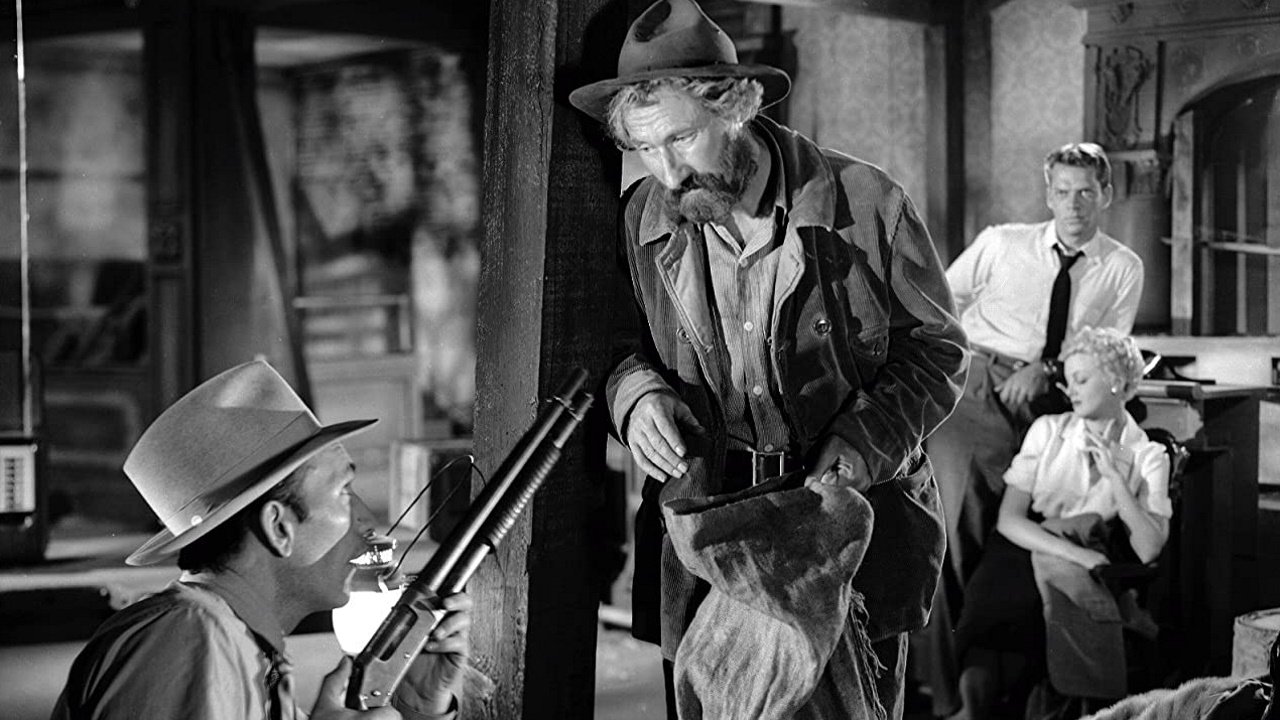
Musuraca frames the group huddled inside a derelict building, the camera positioned low and close so that the ceiling presses down on the composition. A single lantern serves as the practical light source, and Musuraca allows it to do real work: faces emerge from surrounding blackness in partial exposure, one side lit, one side lost. The exterior darkness beyond the window frames is absolute, neither romantically deep nor dramatically stylized but simply empty, which is its own kind of threat. The camera moves rarely, and when it does it is deliberate – a slow push toward a face rather than a cut, giving the viewer no escape from the confinement.
The scene distills the film's central argument: that proximity to death does not ennoble. The characters do not arrive at solidarity or revelation. They calculate. Kay measures Hurley. Dorothy measures Kay. Ashton measures the door. What the frame reveals is not character under pressure but character as pressure – each person reduced to their survival arithmetic, watched by a camera that records without judgment and offers no comfort in the watching.
Nicholas Musuraca earned his reputation at RKO across two decades of low-budget production, and Split Second demonstrates why that reputation holds. Working largely on location in the Nevada desert with studio interiors supplementing the exterior material, Musuraca refuses the easy grammar of wide open spaces. His desert is not liberating; it is exposed, and his lens choices enforce that reading – tighter framings than the landscape would seem to demand, compressing the horizon rather than celebrating it. Interior scenes deploy hard, raking light that models faces sharply and leaves pools of genuine shadow rather than the graduated half-tones of more decorative noir work. Roy Webb's score works against the images rather than with them, which is a credit to both men: the silences Musuraca constructs are substantial enough to need no reinforcement. The overall visual logic supports the screenplay's moral position – in this desert, there is nowhere to hide, and the light, when it finally comes, will be catastrophic.
Tubi has carried Split Second as part of its classic noir holdings; picture quality is acceptable for a title with limited restoration history.
Archive.orgFreeA public domain print is available on Archive.org, though transfer quality varies and the Tubi version is generally preferable.
TCMSubscriptionTCM periodically screens Split Second as part of themed programming blocks; check the schedule for upcoming broadcasts with the best available telecine.