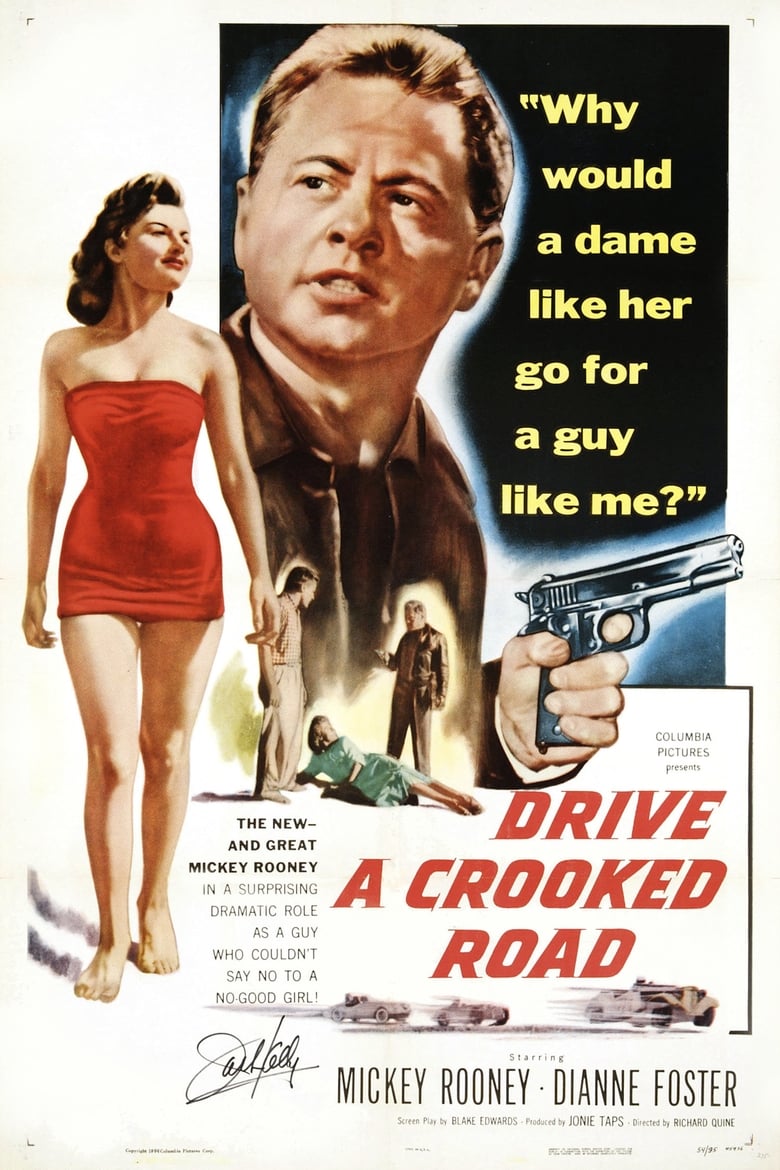
Eddie Shannon (Mickey Rooney) is a small, solitary auto mechanic at a Los Angeles garage, more comfortable under a hood than in conversation. His one distinction is a talent for precision driving, honed on amateur racing circuits. When Barbara Mathews (Dianne Foster) enters his life with apparent warmth and genuine attention, Eddie – unaccustomed to being noticed – falls quickly and completely. She introduces him to Steve Norris (Kevin McCarthy), a charming, calculating man with money to spend and a vague story about where it comes from.
Steve and his associate Harold Baker (Jack Kelly) are planning a bank robbery and need a driver of exceptional skill to navigate the mountain roads from Palm Springs. Barbara, it becomes clear, has been deployed as the lure – her affection for Eddie a professional instrument rather than a personal one. Eddie learns the truth too late, or perhaps chooses to learn it too late, and the question the film begins to press is whether his complicity is born of naivety, loneliness, or a need to believe that someone finally sees him. He joins the job.
Drive a Crooked Road works within the mid-1950s heist cycle but bends it toward psychological territory. The robbery is almost incidental; the real subject is a man whose vulnerability makes him as dangerous as any criminal. Richard Quine keeps the pace tight and the emotional register cold, and Rooney's casting against type pays consistent dividends – his physical smallness made narratively legible, a man the world has trained to feel invisible.
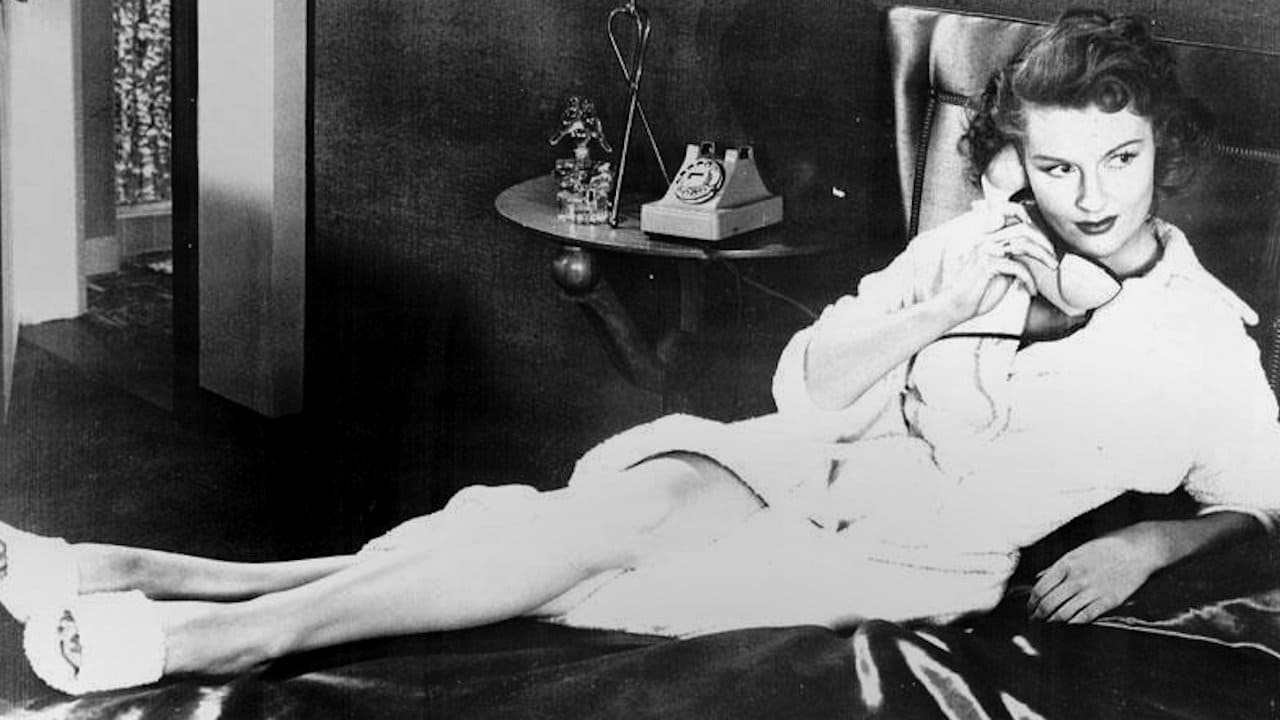
Drive a Crooked Road arrives at a productive intersection in the noir cycle: the postwar heist film absorbing the influence of British social realism and the emerging psychological drama. Richard Quine, not yet regarded as a prestige director, handles the material with compression and restraint. What distinguishes the film is Rooney's performance, which refuses the compensatory swagger his screen persona had cultivated over two decades. Eddie Shannon is a man whose longing is so transparent it becomes a structural flaw, exploited by people who read him accurately on first contact. Kevin McCarthy's Steve Norris operates as the film's true predator – smooth, legible only in retrospect. Dianne Foster navigates the femme fatale position with a degree of internal conflict the script does not fully develop but that she supplies through comportment and pause. Charles Lawton Jr.'s location work in the California hills and the Palm Springs environs gives the film an empirical texture that studio-bound noirs of the period rarely achieve. The film does not rank among the decade's essential works, but it earns its place as a lucid minor entry.
– Classic Noir
Quine and Lawton shoot Eddie's test drive through the mountain roads with the camera mounted low and close, the chassis of the car filling the lower third of the frame while the road curves away into a bleached California sky. There is no dramatic underscoring at full volume – Beitel's score pulls back to let tire noise and wind carry the scene. Lawton cuts between tight cockpit close-ups, Eddie's face stripped of everything but concentration, and wide shots that render the car tiny against the landscape, a controlled object in indifferent terrain.
The sequence functions as Eddie's one moment of complete competence and self-possession, which makes it also the moment the film turns against him. His skill is precisely what makes him usable. The camera's admiration for his driving – steady, unhurried, almost affectionate – underlines the irony: the quality that distinguishes him from ordinary men is the quality that delivers him to people who will discard him. Mastery here is not freedom. It is the mechanism of the trap.
Charles Lawton Jr. brings to Drive a Crooked Road a pragmatic visual intelligence well suited to the film's blue-collar milieu. Working largely on location in the Los Angeles basin and the desert roads east toward Palm Springs, Lawton resists the expressionist shadow-work that defines the studio-bound end of the noir spectrum. His lighting is harder, more ambient, appropriate to a world of garages, diners, and open highway where shadows do not conveniently gather. Interior scenes – Eddie's sparse apartment, the back booths of bars – are lit with a low ceiling of fill that leaves faces readable but never glamorized. The effect is a kind of documentary flatness that makes the characters' vulnerabilities visible rather than poeticized. Lawton favors mid-range focal lengths that keep figures legible within their environments, reinforcing the film's argument that Eddie cannot be separated from the context that shaped him. His work here anticipates the location-driven aesthetic that would dominate American crime cinema by the following decade.
Tubi has carried Drive a Crooked Road in a serviceable transfer and is the most reliably accessible free option for this title.
Amazon Prime VideoRentalAvailable for digital rental; the transfer is comparable to broadcast sources and preferable to degraded public domain prints.
TCMBroadcast/SubscriptionTCM has programmed this title within Rooney retrospectives and Columbia noir cycles; verify current scheduling through their listings.