Films People Pull a Fast One Night Beat Reading Room On TV Shop
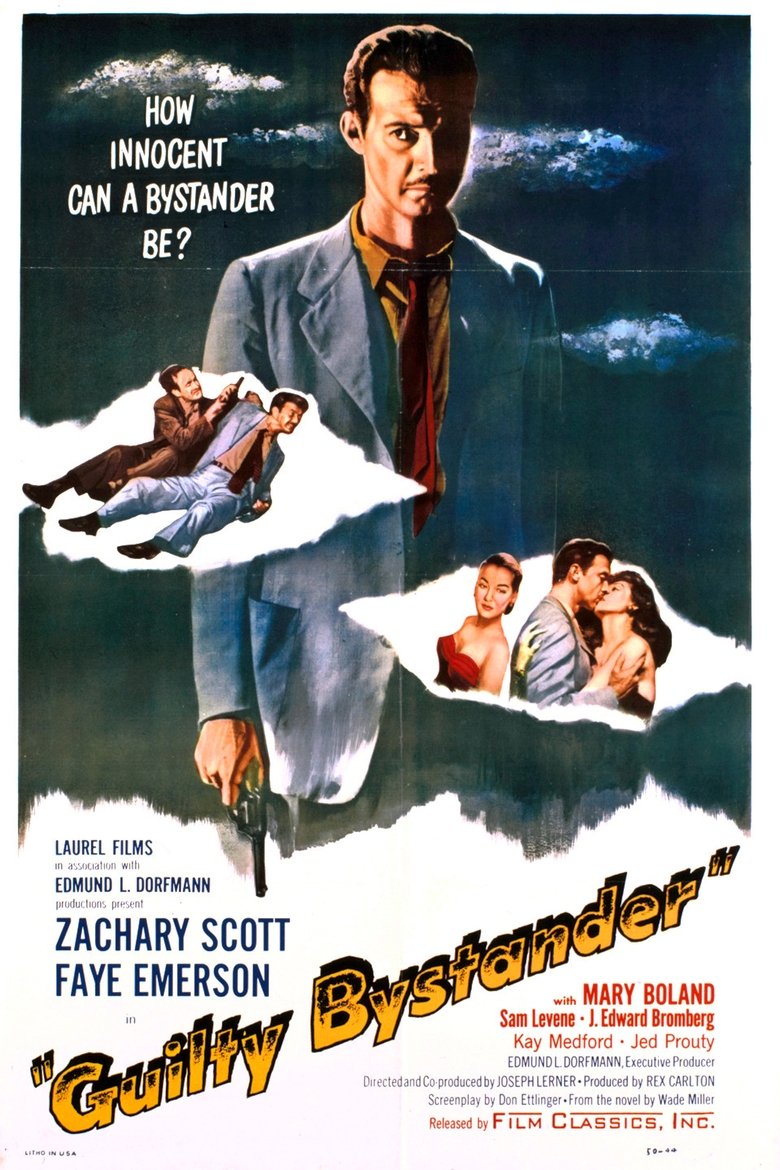
Guilty Bystander 1950
1950 Edmund L. Dorfmann Productions Inc.
★★★☆☆ Notable
Film Noir · 91 minutes · Black & White

Guilty Bystander

Directed by Joseph Lerner
Year 1950
Runtime 91 min
Studio Edmund L. Dorfmann Productions Inc.
TMDB 5.5 / 10
"A disgraced detective searches the city's margins for a missing child and whatever remains of himself."

Max Thursday (Zachary Scott) is a former hotel detective who has drunk himself to the lowest rung of New York's rooming-house world. When his estranged wife Georgia (Faye Emerson) arrives to tell him that their young son has been kidnapped, Thursday has little standing to act – no badge, no contacts worth trusting, and a reputation that precedes him into every room like bad weather. The only currency he still holds is a willingness to go where police cannot or will not.

The trail leads Thursday through a succession of waterfront dives and back-room arrangements, bringing him into contact with the fence Varkas (J. Edward Bromberg), the police captain Tonetti (Sam Levene), who tracks Thursday with equal parts contempt and reluctant reliance, and the boarding-house keeper Smitty (Mary Boland), whose maternal surface conceals a colder interior. Georgia's own motives remain unstable throughout, and the film refuses to settle the question of whether Thursday is rescuing his son or simply punishing himself by other means.

Guilty Bystander belongs to the cycle of mid-period noirs built around the compromised investigator – a figure who is neither the hard-boiled professional nor the innocent wrongly accused, but something more corrosive: a man who understands exactly how far he has fallen and continues falling anyway. The film uses its authentic New York locations to place Thursday's degradation in a specific, recognizable geography, making the moral distance between his former life and his present one measurable in actual city blocks.
Classic Noir

Guilty Bystander arrived in 1950 from an independent production outfit with a modest budget and no major studio apparatus behind it, and those conditions shape almost everything about the film. Joseph Lerner directs without flourish, which serves a story that depends on accumulating pressure rather than set-piece invention. Zachary Scott, largely typecast elsewhere as the smooth villain, finds genuine weight in Max Thursday – a performance built on physical diminishment rather than charm. The film's source is Wade Miller's 1947 pulp novel, and Lerner preserves the novel's insistence that Thursday's alcoholism is not colorful but structural, the organizing fact of his existence around which everything else must negotiate. What the film achieves, quietly, is a portrait of postwar male failure that the prestige productions of the era were careful to sentimentalize. Here the sentimentality is present but contested, undercut by Faye Emerson's unsettling Georgia and by a narrative logic that offers Thursday no clean restoration. Dimitri Tiomkin's score leans spare, resisting the orchestral swells that might soften the film's harder implications.

– Classic Noir
3 ★★★☆☆ Notable
Credits

The Crew

DirectorJoseph Lerner
ScreenplayDon Ettlinger
CinematographyGerald Hirschfeld
MusicDimitri Tiomkin
EditingGeraldine Lerner
ProducerRex Carlton
Performances

The Cast

Close Reading

The Signature Scene

Guilty Bystander – scene
The Waterfront Interrogation Thursday in the Dark

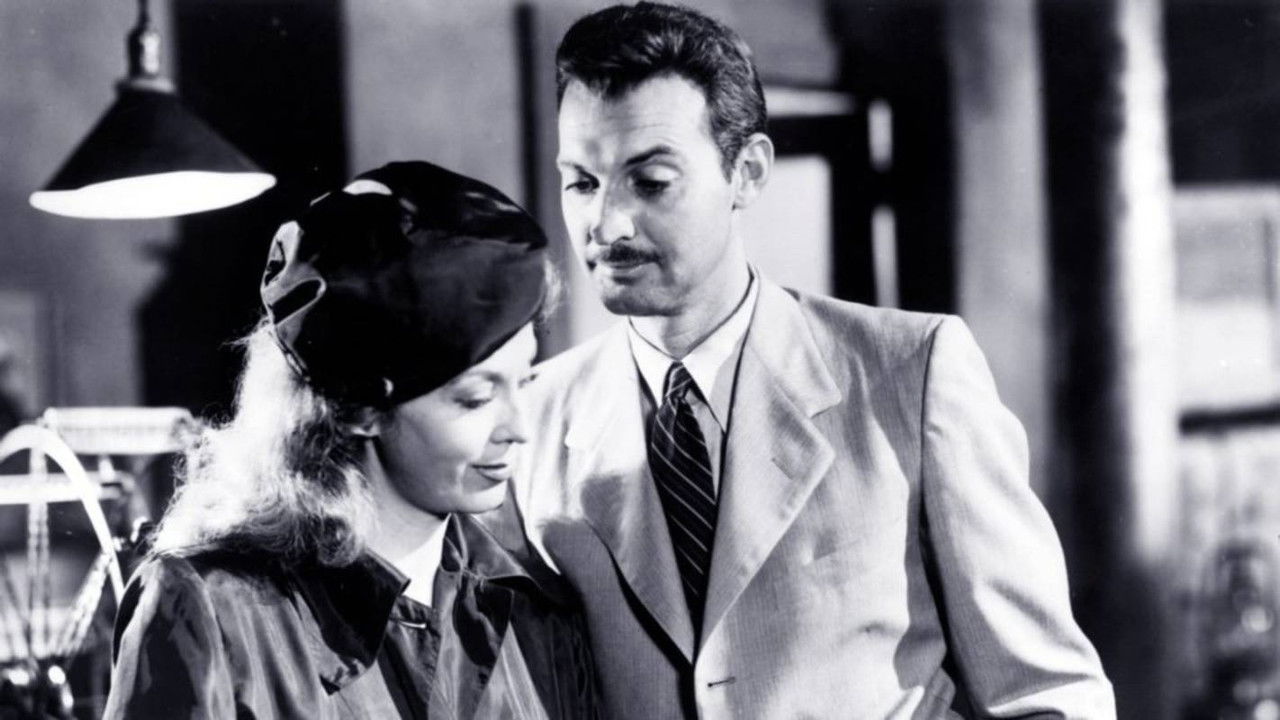
Gerald Hirschfeld holds the camera at a low angle as Thursday presses Varkas against the wet brick of a warehouse interior, the single overhead source throwing a hard cone of light that catches the upper half of Thursday's face and leaves his mouth – the instrument of coercion – in shadow. The frame is crowded by the wall behind Varkas, deliberately reducing the available depth so that there is no exit geometry visible to the eye. Water reflects faintly on the floor. The composition communicates confinement as a shared condition rather than simply a physical circumstance.

The scene isolates what the film argues about Thursday throughout: he is not a man exercising power but a man borrowing it from desperation, and Hirschfeld's framing makes that distinction visible. The darkness that covers the lower half of his face suggests not menace but erasure – the self that once carried authority has been partially effaced, and what remains operates in the spaces the light does not reach. That the interrogation yields information is almost incidental; the scene's real subject is the cost at which Thursday's will still functions.

Visual Language

The Cinematography

🎞️
Gerald Hirschfeld – Director of Photography

Gerald Hirschfeld, working on one of his earliest features, shoots Guilty Bystander with a discipline that turns budgetary limitation into visual argument. The location work in lower Manhattan and along the waterfront gives the film a surface texture no studio set could replicate – wet cobblestones, fire escapes throwing ladder shadows across brick, interiors lit by single practicals that leave the frame's periphery genuinely dark rather than decoratively so. Hirschfeld favors a slightly longer normal lens in the dialogue scenes, compressing the space between characters and removing the possibility of comfortable distance. His shadow work is architectural: shadows here mark territory, indicate where a character stands in relation to the moral structure of the scene rather than simply providing atmosphere. The boarding-house sequences are lit with a sickly overhead quality that gives Smitty's domain the feeling of a space that admits no natural light, while the street exteriors carry the cold, flat grey of overcast winter shooting. The cinematography's consistent logic is that transparency is unavailable – every space in this film filters and obscures.

In the Catalogue

Themes & Motifs

Availability

Where to Watch

Also in the Directory

See Also