Films People Pull a Fast One Night Beat Reading Room On TV Shop
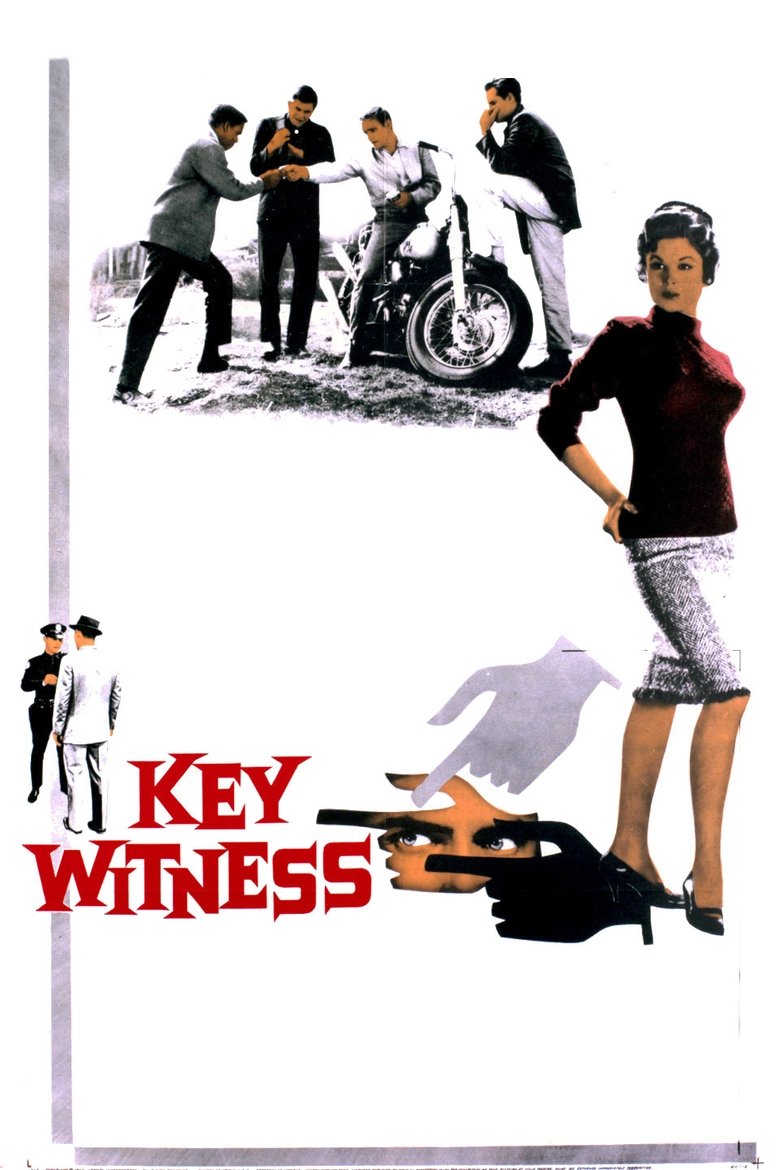
Key Witness 1960
1960 Metro-Goldwyn-Mayer
★★★☆☆ Notable
Film Noir · 82 minutes · Black & White

Key Witness

Directed by Phil Karlson
Year 1960
Runtime 82 min
Studio Metro-Goldwyn-Mayer
TMDB 6.9 / 10
"A man sees a killing and the city decides he should forget it."

Fred Morrow, a suburban family man newly settled in Los Angeles, witnesses a gang murder on a city street. When he agrees to testify, the Los Angeles Police Department assigns Detective Rafael Torno to the case, but the machinery of civic duty moves slower than the gang's capacity for intimidation. Fred and his wife Ann find themselves isolated, their middle-class security proving no insulation against the threat closing in from the streets below.

The gang is led by Cowby, a volatile teenager played with coiled menace by Dennis Hopper, whose authority over his crew – Muggles, Apple, Magician, and the damaged Ruby – rests on spectacle and fear. As pressure mounts on Fred to recant, the film shifts its attention to the gang's internal logic, tracing the way loyalty, cruelty, and adolescent vanity compound into something the law struggles to name, let alone contain. Ruby in particular becomes a figure caught between the gang's violence and her own degraded sense of belonging.

Key Witness works within the civic-conscience strand of late noir, the kind of film that uses a crime plot to examine what American institutions ask of ordinary people and what those people discover about themselves under that pressure. Phil Karlson, whose career repeatedly returned to civic corruption and brutality, frames the witness problem not as a legal abstraction but as a test of whether postwar suburban identity can survive contact with the city it displaced.
Classic Noir

Phil Karlson made a career of films that took institutional violence seriously, and Key Witness belongs in that company alongside The Phenix City Story and The Brothers Rico. What distinguishes it is the casting of Dennis Hopper as Cowby, a performance that carries genuine threat without tipping into caricature, and the film's refusal to sentimentalize the Morrow family's predicament. Jeffrey Hunter's Fred is not a hero who rises to the occasion so much as a man who discovers that doing the right thing is a sustained and costly act. The film is also notable as an early sound role for Johnny Nash, whose presence as Apple adds a racial dimension to the gang's composition that the script handles obliquely but does not entirely ignore. Made at the end of the classical noir cycle, Key Witness reflects an era in which the genre was absorbing juvenile delinquency pictures and social-problem films, producing something leaner and more sociologically alert than the femme fatale model it nominally replaced.

– Classic Noir
3 ★★★☆☆ Notable
Credits

The Crew

DirectorPhil Karlson
ScreenplayAlfred Brenner
Performances

The Cast

Close Reading

The Signature Scene

Key Witness – scene
The Telephone Intimidation Voice Through the Receiver

Karlson keeps the frame tight on Fred at the telephone, the domestic interior behind him rendered shallow and slightly out of focus, its reassuring geometry undercut by the low-angle source light that carves shadows across the wall. The receiver itself becomes the scene's formal center, an object that should mean safety – a line to the outside world – but which now carries the gang's voice directly into the home. The camera does not cut to show us who is calling; it holds on Hunter's face, registering the intrusion through reaction rather than exposition.

The scene encapsulates the film's central argument: that the suburb is not a refuge but a perimeter, and that perimeters can be crossed by wire as easily as by foot. Fred's expression moves through anger toward something more unguarded, a recognition that the civic courage he committed to in daylight requires a different kind of resolve in his own kitchen, with his family in the next room. The telephone becomes a threshold between two versions of American life that the film insists on treating as continuous rather than separate.

Visual Language

The Cinematography

🎞️
Director of Photography – Director of Photography

The cinematographer for Key Witness has not been definitively confirmed in surviving production records, which itself reflects something about the film's marginal status in MGM's 1960 release slate. What can be assessed from the film as released is a visual approach rooted in location work around Los Angeles that gives the city's streets, stairwells, and transit corridors a texture studio construction rarely achieves. The lighting tends toward available-source logic even in interiors, with practical lamps and window light establishing moral geography rather than glamour. Shadows fall as consequences of the environment rather than as imposed expressionist design, which suits Karlson's interest in institutional realism. The camera stays at eye level or slightly below when following the gang, granting them a spatial authority that underscores their control of territory. Wider lenses in confined spaces increase the pressure on actors without calling attention to themselves, a technical restraint that aligns with the film's broader argument that danger is most effective when it looks ordinary.

In the Catalogue

Themes & Motifs

Availability

Where to Watch

Also in the Directory

See Also