Films People Pull a Fast One Night Beat Reading Room On TV Shop
Shakedown 1950
1950 Universal International Pictures
★★★☆☆ Notable
Film Noir · 80 minutes · Black & White

Shakedown

Directed by Joseph Pevney
Year 1950
Runtime 80 min
Studio Universal International Pictures
TMDB 6.4 / 10
"A photographer with a talent for being in the wrong place learns to make that pay."

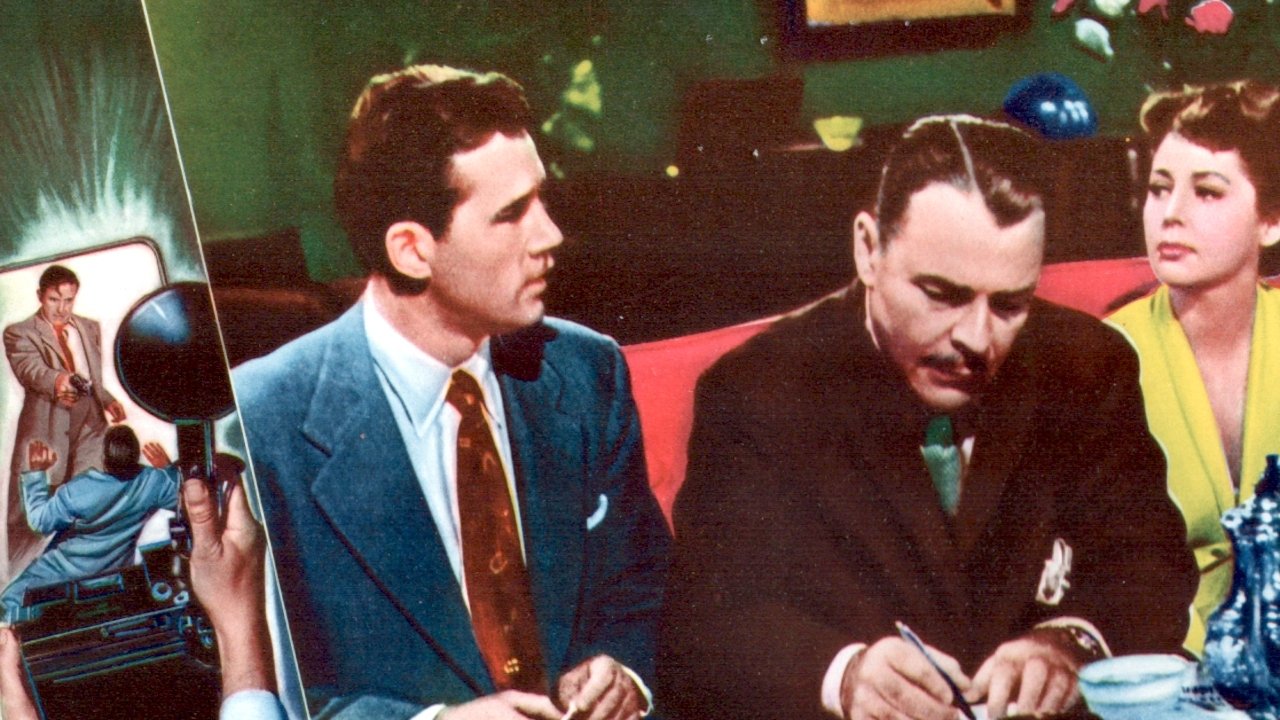
Jack Early arrives in San Francisco with a camera, ambition, and no particular scruples. He talks his way onto a newspaper as a freelance photographer, cultivating a knack for arriving at crime scenes before the police and selling the pictures to whoever pays best. His early success brings him into contact with Nick Palmer, a polished racketeer who recognizes in Jack a useful instrument, and with Ellen Bennett, a newspaper colleague whose decency serves as the film's moral counterweight to Jack's calculated opportunism.

Jack's arrangement with Palmer deepens from professional convenience into something more compromised. He begins photographing crime scenes not merely to report them but to document them for Palmer's benefit – evidence that can be leveraged, rivals that can be neutralized, secrets that have a market value. Lawrence Tierney's Harry Colton, a blunt enforcer in Palmer's orbit, represents the brute cost of the world Jack has chosen to inhabit, while Palmer's wife Nita introduces a further complication that tests the already fragile boundaries of Jack's self-interest.

Shakedown belongs to a strand of postwar noir preoccupied less with detection than with moral erosion – the story of a man who mistakes calculation for intelligence and discovers the difference too late. The film uses the press photographer as a figure for the predatory gaze itself, someone who profits from others' worst moments and eventually cannot distinguish observation from complicity. The trajectory is familiar but the professional milieu gives it a specific, cynical texture that distinguishes it from more conventional crime narratives of the period.
Classic Noir

Shakedown is a minor but pointed entry in Universal International's postwar crime cycle, directed by Joseph Pevney with an economy that serves the material well. Howard Duff, still trading on the hard-edged authority he developed in radio's Sam Spade, plays Jack Early as a man whose charm is inseparable from his corruption – the performance avoids the trap of making the protagonist merely sly, instead suggesting someone who has genuinely confused cynicism with realism. Brian Donlevy brings his customary controlled menace to Palmer, and Lawrence Tierney, already typecast but entirely effective, functions as a reminder of what violence looks like without the social veneer. The film's use of San Francisco locations gives it a documentary texture that contrasts productively with the studio-bound moral geometry of the plot. What Shakedown reveals about its era is the degree to which postwar American cinema had absorbed the idea that professional ambition and ethical vacancy were not merely compatible but mutually reinforcing – a proposition that the noir cycle examined with a consistency that no other Hollywood genre of the period could match.

– Classic Noir
3 ★★★☆☆ Notable
Credits

The Crew

DirectorJoseph Pevney
ScreenplayNat Dallinger
CinematographyIrving Glassberg
MusicDaniele Amfitheatrof
EditingMilton Carruth
Art DirectionRobert Clatworthy
CostumesYvonne Wood
ProducerTed Richmond
Performances

The Cast

Close Reading

The Signature Scene

Shakedown – scene
The Darkroom Confrontation Evidence in the Developer Tray

The camera holds close on a photograph emerging in the developer tray, the image resolving in real time from gray murk into incriminating clarity. Irving Glassberg lights the darkroom almost entirely with the amber glow of the safelight, casting everything in a single contaminated color that flattens faces and removes the usual moral legibility of shadow and highlight. Jack stands over the tray and the frame compresses around both man and image until they occupy the same plane, the photograph and the photographer equally implicated.

The scene crystallizes the film's central argument about the act of looking. Jack has positioned himself as a neutral recorder of events, a professional whose camera is simply a tool, but the emerging photograph makes the neutrality untenable. What he has documented is not news but leverage, and the moment the image becomes visible he can no longer pretend otherwise. The darkroom, which should be a space of revelation, becomes instead the site of a choice he has already made without admitting it.

Visual Language

The Cinematography

🎞️
Irving Glassberg – Director of Photography

Irving Glassberg, who shot a substantial portion of Universal International's mid-budget crime output during this period, brings to Shakedown a practical intelligence about how light behaves in working environments. He resists the more theatrical shadow arrangements associated with the genre's prestige productions, preferring instead a documentary naturalism disrupted at key moments by hard side-lighting that isolates faces against undifferentiated backgrounds. The San Francisco location work gives the film a spatial honesty that studio-bound noirs often lack – streets have depth, interiors have the slightly cluttered specificity of real rooms rather than dressed sets. Where Glassberg's work is most pointed is in his treatment of Jack's camera as an object within the frame: the Graflex appears repeatedly as a compositional element, its lens rhyming with and ironizing the cinema camera recording Jack recording the world. The cinematography does not editorialize about Jack's moral condition but simply renders it visible, which is the more economical choice.

In the Catalogue

Themes & Motifs

Availability

Where to Watch

Also in the Directory

See Also