Sam Grover is a man whose family has grown tired of waiting for him to die. Presumed dead after disappearing in a hotel fire, Sam has in fact been hiding out, collaborating with his scheming wife Edna in an insurance fraud designed to free them both from debt and obligation. Edna, positioned as the grieving widow collecting on the policy, is already involved with Ray Belden, a younger man who represents the future she wants. The plan is clean on paper: Sam stays hidden, the money comes in, and no one asks the wrong questions.
The scheme begins to unravel when Tom Grover, Sam's son from a prior life, grows suspicious of his stepmother's conduct and the circumstances surrounding his father's alleged death. Insurance investigator Hutton is also closing in, methodically assembling the inconsistencies that expose the fraud. Meanwhile, the triangle between Edna, Ray, and the inconveniently living Sam generates its own pressure – loyalty and desire prove unreliable currencies, and the alliance holding the plan together begins to fracture along exactly the lines one would expect when self-interest is the only shared value.
Shed No Tears operates within the tightly compressed tradition of the B-noir, where limited resources demand economy of character and incident. The film belongs to a cycle of postwar domestic crime pictures in which the institution of marriage is the site of betrayal rather than safety, and in which women who want more than circumstance has granted them become the engine of catastrophe. It is less interested in suspense as spectacle than in the gradual, procedural exposure of a moral failure that was built into the original arrangement.
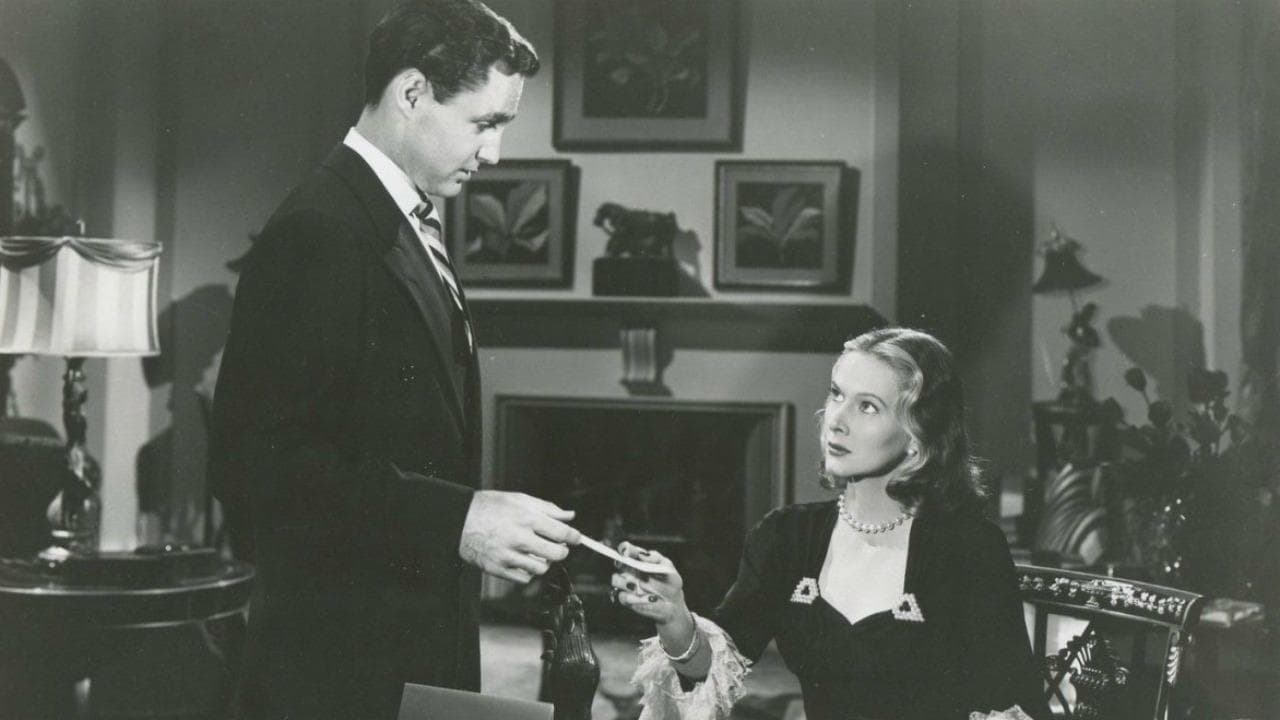
Shed No Tears is a minor entry in the postwar B-noir cycle, produced by Equity Pictures outside the major studio system with the constraints that implies – a short runtime, a limited budget, and a cast assembled from the reliable second tier of Hollywood character players. Jean Yarbrough, primarily known for comedy programmers, handles the material with more restraint than his background might suggest, allowing the film's central situation – a faked death, a faithless wife, a fraud that metastasizes into something worse – to carry its own weight without melodramatic inflation. June Vincent's Edna is the film's real subject: a woman whose cupidity is presented not with censure but with a certain flat clarity, as though the film understands she is the product of the same economic anxieties the era produced in abundance. Wallace Ford brings a weathered credibility to Sam, a man whose complicity in his own erasure is the story's most quietly damning detail. The film does not transcend its category, but it works honestly within it.
– Classic Noir
The camera holds a medium two-shot as Edna faces Sam in the cramped interior that has served as his ersatz grave. Frank Redman's lighting divides the frame with deliberate asymmetry – Edna occupies the brighter half, positioned near the window, while Sam is pushed into the ambient shadow that has defined his existence since the fraud began. There is no camera movement to speak of; the stillness is compositional argument. The space between them is not intimacy but the geometry of a transaction being renegotiated under duress.
The scene crystallizes what the film has been building: Sam is not a victim in any simple sense, because he authored his own disappearance, but the room makes clear that Edna has already moved on in every way that counts. His physical presence is an inconvenience she is calculating how to resolve. The moral logic of the film surfaces here – that the erasure of a person, even a willing one, creates obligations that do not disappear with the paperwork.
Frank Redman's cinematography on Shed No Tears is the work of a craftsman who understood what the budget required and delivered it without waste. Shooting on confined studio sets that stand in for domestic interiors and unremarkable middle-American spaces, Redman relies on hard side-lighting and compressed depth to generate unease from environments that would otherwise be visually inert. His lens choices favor the middle focal range, keeping faces readable without the distorting intimacy of a wider glass – appropriate for a story in which everyone is performing for one another. Shadow work is functional rather than expressionistic: darkness pools in corners and along walls to signal moral enclosure without announcing itself as style. The result is a visual language that serves the film's procedural register, grounding its crimes in the recognizable textures of postwar domestic life rather than the stylized underworld that bigger-budget noirs could afford to construct.
Shed No Tears is in the public domain and available as a full streaming transfer on Archive.org, making it the most immediately accessible option, though print quality varies by upload.
TubiFreeTubi has carried public domain B-noirs of this vintage with some regularity; availability fluctuates, so confirming before viewing is advisable.
KanopySubscriptionKanopy's library of independent and public domain noir titles makes it a reasonable place to check for a cleaner transfer, subject to your library's institutional access.