Films People Pull a Fast One Night Beat Reading Room On TV Shop
Strange Impersonation 1946
1946 W. Lee Wilder Productions
★★★☆☆ Notable
Film Noir · 68 minutes · Black & White

Strange Impersonation

Directed by Anthony Mann
Year 1946
Runtime 68 min
Studio W. Lee Wilder Productions
TMDB 6.1 / 10
"A woman erases herself to survive – and finds the erasure harder to undo than the crime."

Nora Goodrich is a research chemist engaged to Dr. Stephen Lindstrom, a man whose wandering attention has already fixed itself on her laboratory assistant, Arline Cole. When an experimental anesthetic is accidentally discharged during a late-night session, Nora is badly disfigured – and begins to suspect the accident was no accident at all. She submits to reconstructive surgery under the care of Dr. Mansfield, an elderly plastic surgeon whose skill offers her not merely a restored face but an unexpected opportunity.

Emerging from surgery with altered features, Nora assumes the identity of a dead woman, Jane Karaski, and begins to reconstruct her life from the outside, watching Arline maneuver toward Stephen and toward Nora's own former position. The deception generates its own momentum: blackmail enters, then the threat of exposure, and eventually murder. Inspector Malloy presses the investigation with methodical persistence while J. W. Rinse, attorney for the plaintiffs, applies legal pressure from another angle, tightening the frame around a woman who has already once remade herself.

Strange Impersonation belongs to the cycle of mid-forties noir that locates its danger not in the underworld but in the professional middle class – laboratories, consulting rooms, legal offices. The film is compact, structured around a conceit that might have remained a programmer's gimmick but instead becomes a vehicle for examining how identity, once shed, cannot be cleanly reclaimed. Anthony Mann directs with the controlled economy he would soon apply to far larger canvases.
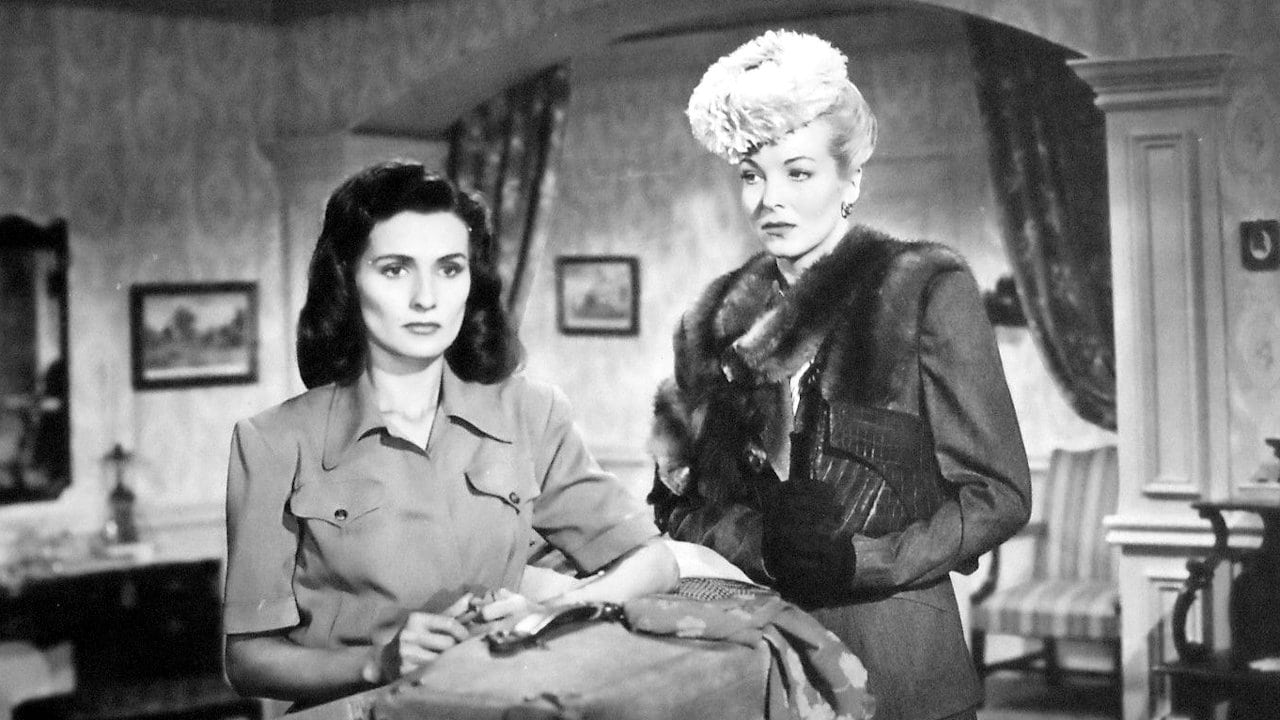
Classic Noir

Strange Impersonation is a minor entry in Anthony Mann's pre-Winchester '73 output, yet it repays attention precisely because of its constraints. Produced by W. Lee Wilder on an evidently thin budget and running under seventy minutes, it demonstrates how Mann could impose visual discipline and narrative tension on unpromising material. The film's central device – a woman who survives disfigurement and uses surgery as cover for a new life – anticipates the identity-dissolution themes Mann would pursue with greater resources in Raw Deal and later in his westerns. What the film reveals about its postwar moment is the particular anxiety around women's professional ambition: Nora is a scientist of genuine ability, and the narrative punishes her not for weakness but for competence and the envy it attracts. Brenda Marshall carries the picture with a reticence that reads as controlled grief rather than passivity. The film will not satisfy viewers seeking the full expressionist arsenal of period noir, but as a document of the B-picture's capacity for modest seriousness, it earns its place in the catalogue.

– Classic Noir
3 ★★★☆☆ Notable
Credits

The Crew

DirectorAnthony Mann
ScreenplayLewis Herman
CinematographyRobert Pittack
EditingJohn F. Link Sr.
Art DirectionEdward C. Jewell
ProducerW. Lee Wilder
Performances

The Cast

Close Reading

The Signature Scene

Strange Impersonation – scene
The Surgery Recovery Room Bandaged Face, New Self

The camera holds on Nora in medium close-up as the surgical bandages are removed, her face still partially obscured by gauze and the uncertain light of a small clinical lamp. Robert Pittack positions the key light low and slightly off-axis, so that shadows gather at the edges of the frame rather than across the subject's features – an inversion of the standard noir shadow-masking technique. The effect is of a face emerging from darkness rather than retreating into it, the composition holding ambiguity about whether what is revealed is restoration or transformation.

The scene crystallizes the film's central argument: that identity is a surface, and surfaces can be remade. Nora's expression, as she studies her new reflection in the hand mirror Dr. Mansfield provides, registers neither relief nor triumph but a kind of provisional calculation. The moment refuses sentimentality. It establishes that the woman who walks out of that room has not been saved so much as equipped – and that the equipment will carry its own costs.

Visual Language

The Cinematography

🎞️
Robert Pittack – Director of Photography

Robert Pittack shoots Strange Impersonation in the cramped conditions of low-budget studio production, and the visual strategy is one of selective compression rather than expansive chiaroscuro. He favors tight framings that make walls and door frames into compositional pressure points, reinforcing the sense that Nora has nowhere to move without risk of exposure. Lighting setups rely on single-source practicals supplemented by narrow fill, keeping shadow work functional rather than decorative – shadow here signals enclosure rather than moral ambiguity in the expressionist sense. The laboratory sequences, which open the film, use overhead fluorescent simulation to establish an institutional coldness that contrasts sharply with the domestic and legal spaces Nora subsequently inhabits. Pittack does not have the resources or the mandate to construct the kind of sustained visual poetry found in Mann's collaborations with John Alton, but he achieves a consistent visual grammar: the frame tightens as the deception deepens, and the camera's proximity to faces in interrogation scenes translates psychological pressure into spatial terms.

In the Catalogue

Themes & Motifs

Availability

Where to Watch

Also in the Directory

See Also