In mid-Victorian England, Walter Hartright arrives at Limmeridge House to serve as drawing teacher to Laura Fairlie, a young heiress of fragile temperament, and her half-sister Marian Halcombe, a woman of considerably stronger resolve. Before taking the post, Walter encounters a distressed woman in white on a moonlit road – Ann Catherick, an escapee from a private asylum whose haunted resemblance to Laura carries an implication neither man nor woman can yet read. Walter falls in love with Laura, but she is already committed by her guardian uncle Frederick Fairlie to a mercenary marriage with the coldly ambitious Sir Percival Glyde.
Once Laura is delivered into Glyde's hands at Blackwater Park, the trap tightens. Glyde is in debt and needs Laura's fortune; his confidant, the corpulent, cultured, and utterly ruthless Count Fosco, provides the intellectual architecture for a scheme that exploits Ann Catherick's likeness to Laura with lethal precision. Marian fights to protect her sister, but Fosco's intelligence and the weight of Victorian property law leave her almost without recourse. The film turns on the question of whether identity itself can be legally and socially erased – whether a living woman can be made to disappear into the record of a dead one.
Woman in White operates in the contested territory between Gothic melodrama and noir, where the threat is not the urban underworld but the domestic interior: the locked room, the forged document, the family physician who asks no inconvenient questions. The film positions its women as the primary victims of a system designed to convert them into property, and reserves its darkest irony for the men who administer that system with perfect legality and considerable charm.
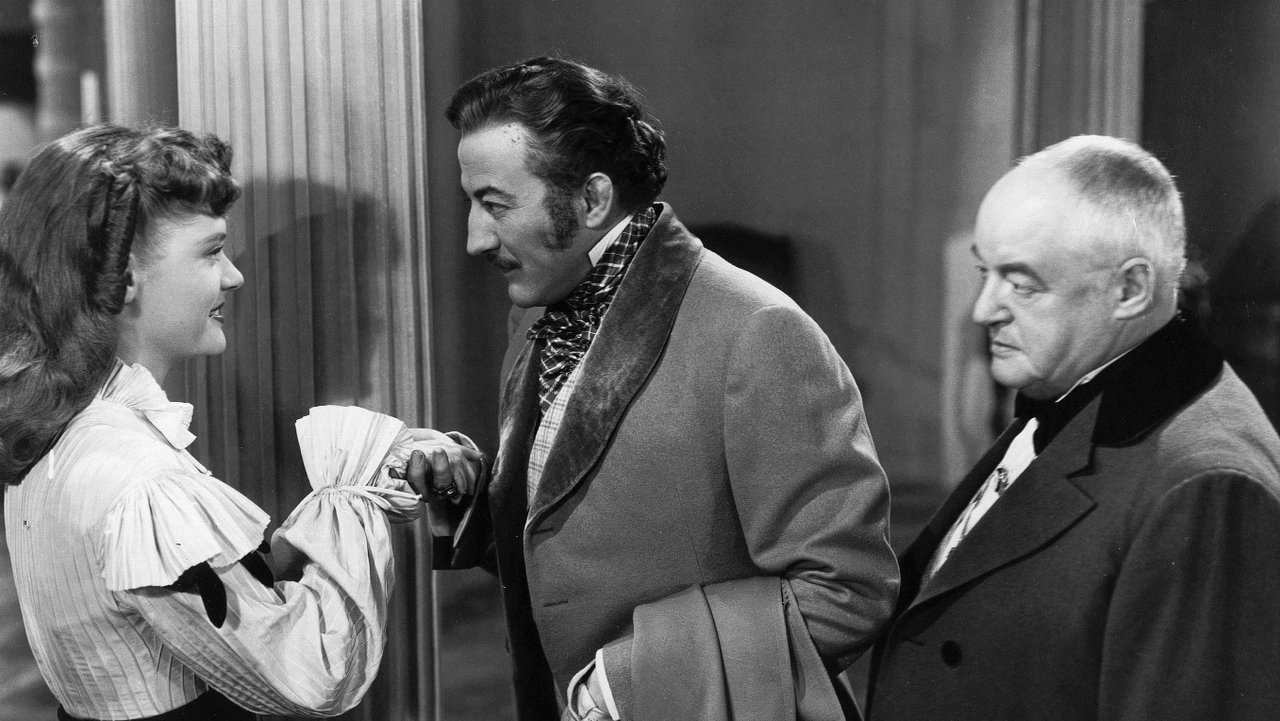
Warner Bros.' adaptation of Wilkie Collins's 1859 novel arrives in 1948 as a period noir, which is to say a film more interested in structural power than in shadowed streets. Peter Godfrey's direction is not distinguished, but the film's casting is cannily considered: Sydney Greenstreet as Count Fosco transforms what might have been operatic villainy into something more unsettling – a man of genuine aesthetic refinement who treats human lives as problems in logic. Agnes Moorehead's Countess Fosco, reduced almost to silence, becomes a study in what domination looks like after it has been fully internalized. Eleanor Parker carries the double role of Laura and Ann Catherick with a precision that the screenplay does not always deserve. What the film finally reveals about its era is the ease with which postwar Hollywood, working in period costume, could anatomize the mechanics of female subjugation without appearing to argue a contemporary case – a displacement that both protects and slightly diminishes the film's force.
– Classic Noir
Carl E. Guthrie frames the scene in a low-ceilinged corridor where institutional architecture compresses the space to near-suffocation. The light source is lateral and hard, throwing one side of Eleanor Parker's face into near-complete shadow while the paperwork before her sits in full, bureaucratic illumination. The camera holds on a medium shot that refuses to cut away to reaction; we watch the transaction complete itself in real time, the pen moving across the document with the unhurried confidence of men who have arranged everything in advance.
The scene argues the film's central case without a word of exposition: legal identity is a document, and a document can be falsified by those with access to the right institutions. Parker's stillness here is not passivity but shock – the expression of a person who has discovered that the social world she trusted has been constructed entirely against her. Fosco does not need to threaten. The system threatens on his behalf.
Carl E. Guthrie shoots Woman in White on Warner Bros. studio sets with a consistency of intent that period productions of this era rarely sustain. His approach rejects the high-contrast expressionism that defined Warner noir in the early 1940s in favor of something more suffocating: graduated shadow that seeps into rooms rather than cutting across them, suggesting enclosure rather than immediate threat. Interior spaces at Blackwater Park are lit to enforce a sense of depth that terminates in darkness – doorways open onto nothing the eye can resolve. Guthrie reserves sharper, more analytical light for Count Fosco, whose menace is illuminated rather than hidden, a choice that correctly identifies him as a man who has nothing to fear from being seen clearly. Laura, by contrast, moves through a consistently softened field that anticipates her erasure. The cinematography does not simply record the Gothic atmosphere; it enacts the film's argument that visibility and power are unevenly distributed along lines of gender and wealth.
As a Warner Bros. production, Woman in White periodically appears in the Warner catalogue on Max; availability varies by region and should be confirmed.
TCMBroadcast / StreamingTCM remains the most reliable broadcast home for this title and occasionally makes it available via the TCM app for authenticated cable subscribers.
Archive.orgFreeA public-domain or out-of-region upload may be findable on Archive.org, though print quality is not guaranteed and availability shifts without notice.