Detective Paul Sheridan is assigned by Lieutenant Carl Eckstrom to surveil Lona McLane, the girlfriend of a bank robber named Harry Wheeler who is still at large with the stolen money. The stakeout is routine police work – long nights, parked cars, venetian-blind shadows – until Sheridan makes contact with Lona under a false pretense and finds himself drawn into something he cannot professionally afford. Kim Novak plays Lona as a woman who understands exactly the effect she produces, and Fred MacMurray's Sheridan, a veteran cop who should know better, begins rationalizing the first in a series of increasingly irreversible decisions.
Sheridan's partner Rick McAllister and their neighbor across the way, nurse Ann Stewart, complicate the geometry. McAllister is loyal and observant in ways that become dangerous; Ann represents a saner life that Sheridan is already moving away from. When Wheeler resurfaces and the situation demands action, Sheridan finds himself not enforcing the law but improvising around it – covering evidence, protecting Lona, and discovering that each compromise requires a larger one to follow. The film is precise about the mechanism of self-destruction: no single moment is catastrophic, only cumulative.
Pushover arrives four years after Double Indemnity established the template MacMurray would now revisit from a different angle, and the film is alert to that inheritance without being enslaved by it. Richard Quine keeps the procedural texture intact long enough that the noir undertow registers as deviation rather than premise. What the film builds toward is less a crime story than a study in the distance between what a man tells himself and what he is actually doing – a distance that, in noir, is always fatal.
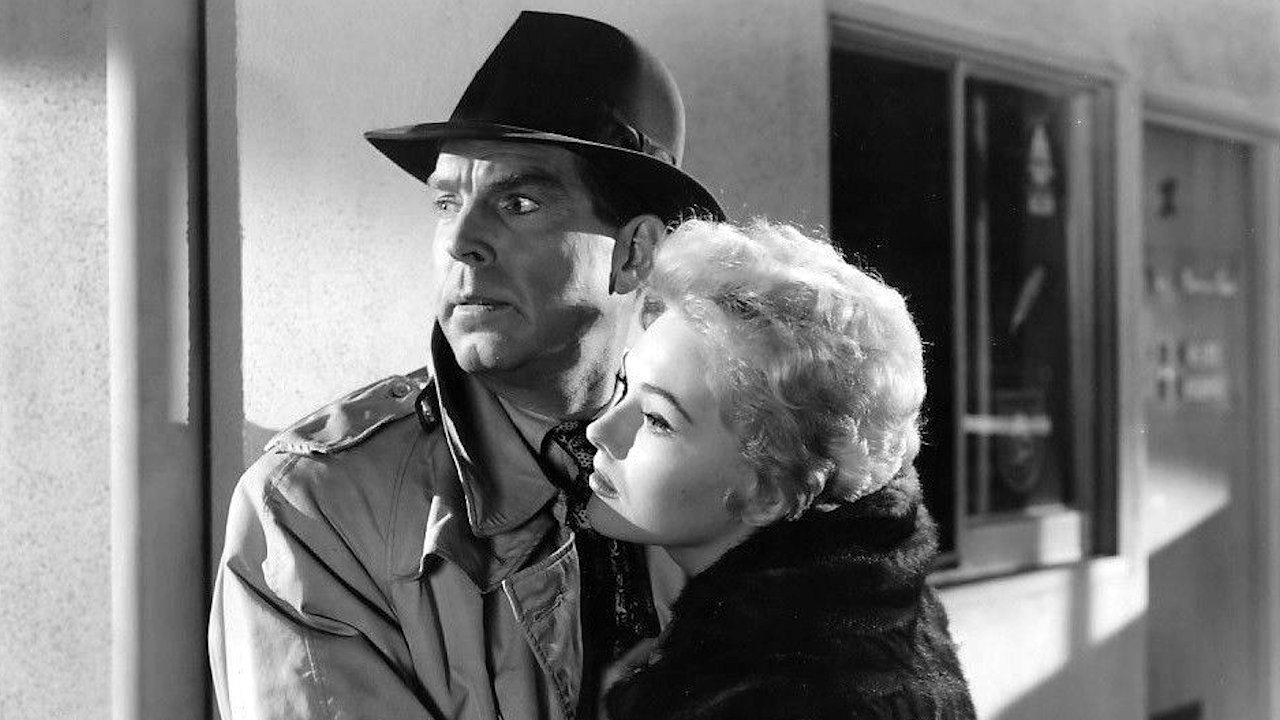
Pushover is a more carefully constructed film than its reputation suggests. Arriving as Kim Novak's screen debut, it has often been read as a star-making vehicle with a borrowed MacMurray and a borrowed plot, but that reading undersells Richard Quine's control of pacing and moral atmosphere. The film understands the stakeout not merely as procedure but as metaphor: a man paid to watch develops a proprietary relationship with what he sees, and that relationship is the corruption. MacMurray, whose casting inevitably summons Double Indemnity, is used knowingly – the audience carries the weight of that earlier film into every scene, which means Sheridan's fall reads as both familiar and preventable, and therefore more damning. Lester White's cinematography keeps the domestic and the illicit in the same visual register, so that the moral slide is never marked by a change in style. Dorothy Malone's Ann Stewart functions as the film's suppressed conscience – present, credible, and consistently sidelined by a man who has already decided. Pushover belongs to the productive middle tier of studio noir: not a landmark, but a film that does precisely what it intends with economy and intelligence.
– Classic Noir
Sheridan sits at the darkened window of the surveillance apartment, the venetian blinds throwing lateral bars of shadow across his face and chest. Lester White frames him in medium close-up with the practical light source behind the blinds reducing his features to alternating planes of illumination and darkness. Across the street, Lona's window glows warmly – a separate world, artificially bright, visually accessible and physically remote. The camera does not cut to her immediately; it holds on Sheridan watching, so that the audience occupies his position and inherits his investment in the image.
The scene makes the film's central argument in purely visual terms. The detective's professional role is to observe without being observed, to remain outside. But the framing has already collapsed that distance: the shadow pattern on Sheridan's face is identical to the one that will later mark the guilty men in this genre, and the warm light across the street is not an object of surveillance so much as an object of desire. Watching, the film suggests, is never neutral – it is always a form of wanting, and wanting, in noir, is where the trouble begins.
Lester White's cinematography for Pushover operates within the conventions of studio noir while applying them with a clarity that reinforces the film's moral logic. Shot largely on Columbia's back lots and interior stages, White uses the controlled environment to maintain precise shadow architecture – the repeated motif of venetian blind patterns printed across faces and walls signals complicity and entrapment without editorial intrusion. His lighting setups favor side-key sources that bisect faces cleanly, reflecting a world where characters are neither wholly exposed nor wholly hidden. The surveillance apartment, which anchors much of the film's first half, is rendered with a flat institutional brightness that makes the warmly lit windows across the street feel like temptation rendered literal. White avoids the expressionist distortion favored in harder-edged noir, keeping his frames compositionally stable, which means the moral disorder must be read in behavior rather than style – a discipline that suits Quine's procedural approach and makes the eventual rupture more effective for being visually unannounced.
The most likely home for a clean, contextualized presentation of this Columbia title; confirm current availability before viewing.
TubiFreeTubi has carried a number of mid-period Columbia noir titles at no cost, though stream quality and availability vary.
TCMSubscriptionTCM periodically programs Pushover in MacMurray or Novak retrospectives; check the schedule for upcoming broadcasts.